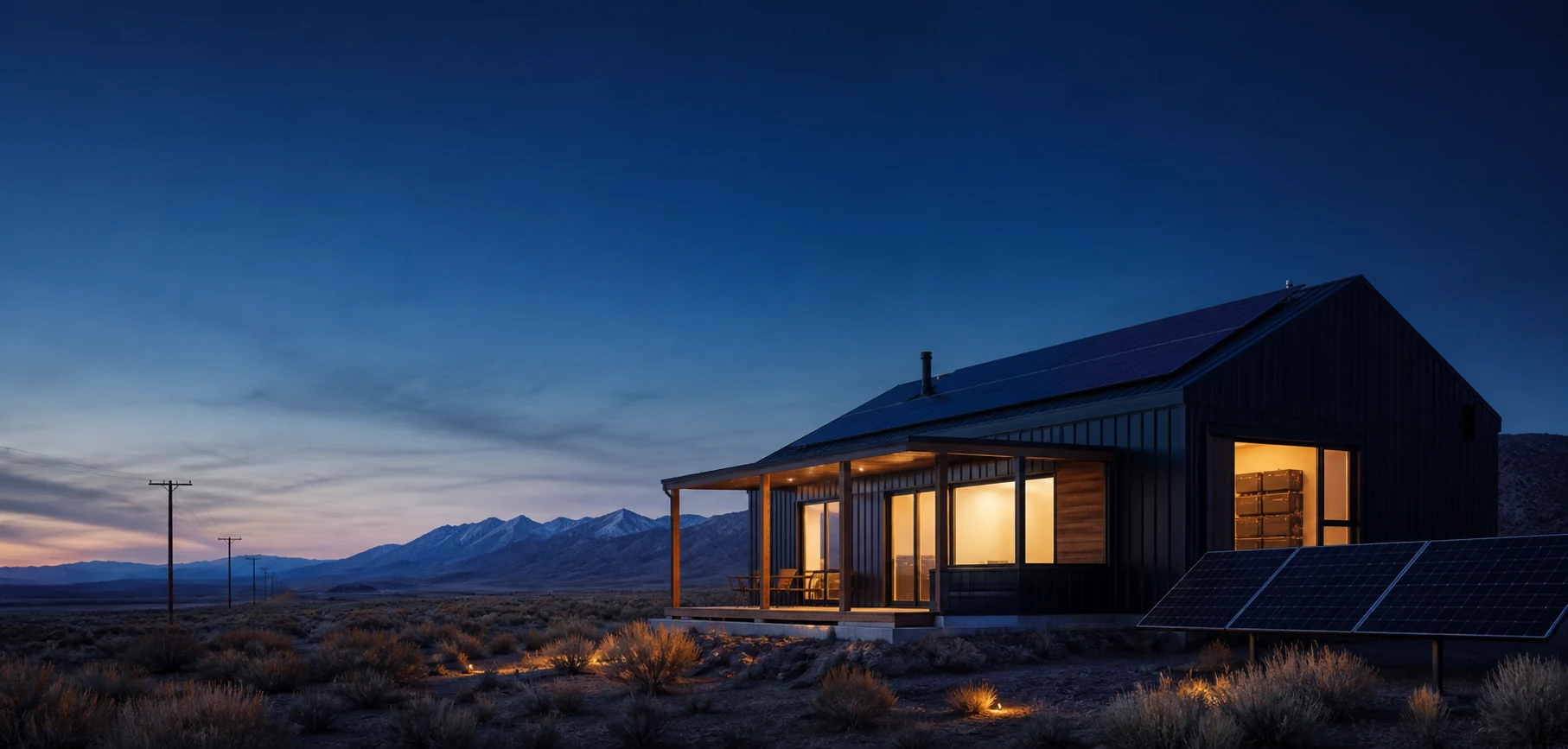
A modern solar-powered home with battery storage in the high desert at dusk

Independent power for new builds

Don’t spend $40,000 on a wire.

If the utility wants $40,000 just to reach your new home, compare that check with a properly designed independent-power system. One buys a connection—and a monthly bill. The other buys generation, storage, and control.

$40,000 is a real long-extension scenario, not a national average. Your written quotes decide the math.

Own the equipment Engineer the reserve Keep the control

Pay for capacity, not access

A connection buys permission.
A system buys power.

A utility-extension check disappears into trenching, poles, transformers, and service access. Solar, batteries, an inverter, and a backup plan become equipment at your home. When independent power costs less than the extension, the capital advantage begins at commissioning—not years later.

Utility path

$40k

A wire to someone else’s system.

  • Extension infrastructure
  • Monthly fixed and usage charges
  • Rates and export rules can change

Independent path

Your asset

Generation. Storage. A plan.

SunArrayInverterBatteryHome
  • Equipment installed at your property
  • Loads and reserve designed around your life
  • Serviceable, expandable, understandable

Your first-year comparison

No fantasy math.

Use written quotes. Include maintenance, backup fuel, and a replacement reserve. This model compares cash outlay; it is not an investment-return promise.

First-year advantage = connection quote + 12 months of utility charges − system quote − annual independent-power costs

Illustrative first-year advantage $3,800 Independent power is lower-cost in year one under these inputs.

Planning estimate only. Excludes financing, incentives, taxes, generator purchase, unusual site work, and any cost or benefit you do not enter.

No feeder. No rate case. No waiting.

The grid is optional.
Responsibility isn’t.

Your home does not have to wait for a feeder repair, transformer replacement, or truck roll. It does depend on disciplined design: measured loads, enough storage, an honest winter-solar model, critical-load priorities, and a tested backup path.

A grid outage is not your event. Reserve still is.

Residential infrastructure

Not a cabin hack.
Not a science project.

Solar is mature infrastructure. DOE expects PV systems to operate for 20–30 years, while NREL found the large majority of systems it studied performed close to predicted production. The panels are proven. Design, installation, storage, and service decide the whole system.

Load auditWinter modelCritical-load planBackup pathMonitoringServiceability

Solid does not mean maintenance-free. It means planned failures do not become house-dark events.

A homeowner reviewing an independent-power wiring plan with a professionally installed inverter and closed battery cabinets
Owner-led. Professionally designed and commissioned.

Understand every watt. Hire for every amp.

DIY-friendly.
Not DIY-reckless.

Do the load audit. Choose what must run and what can wait. Plan cable paths and future expansion. Learn the operating margin so your system never feels like a black box.

Bring qualified local professionals into engineered design, permitting, grounding, overcurrent protection, battery fire safety, service work, and commissioning. Ownership is the goal. Unsafe improvisation is not.

I want a co-built system

A meter is a subscription

Net-positive energy is not a zero bill.

You can produce as much energy as you use and still owe the utility. Fixed charges, time-of-use prices, export credits, and interconnection rules are tariff decisions outside the homeowner’s control.

The policy may change. That is the point: the policy is not yours.

Make power where you use it

No daily fuel stream.
No pretending it is impact-free.

Panels and batteries are manufactured, mined, shipped, and eventually retired. Storage also loses some energy in every cycle. But solar has far lower lifecycle greenhouse-gas and air-pollutant emissions than fossil generation, and it produces power at the home that uses it.

Efficiency comes first. A tighter envelope and efficient loads mean fewer panels, fewer batteries, lower cost, and less material.

The cleanest system is the smallest one that reliably does the job.

Your build. Your power.

Get the utility quote.
Then get the independent quote.

Sign up with your ZIP code and build stage. Ungrid will review the request and email you if we identify an installer serving your area.

Sign up for an installer introduction

No equipment credentials. No exact address. No automated handoff.

Installer availability varies. Ungrid does not guarantee availability, workmanship, pricing, permitting, savings, or system performance. Verify licensing, insurance, references, scope, warranties, and local requirements before hiring.

Sources, assumptions, and the honest fine print

The $40k scenario

Long service extensions can reach this range. Vermont Electric Cooperative publishes examples of approximately $37,000 for a four-pole overhead extension and $42,400 for a longer underground extension, with actual cost dependent on the project. Puget Sound Energy’s 2025 tariff yields more than $44,000 for a 1,000-foot overhead primary extension before several other costs.

Vermont Electric Cooperative Puget Sound Energy Schedule 85

System cost and resilience

NREL’s Q1 2023 benchmark modeled an 8 kW residential PV system with 12.5 kWh of storage at about $37,600 in 2022 dollars. That is not an off-grid whole-home quote and excludes several site-specific costs. DOE explains that solar plus properly configured storage can island from the grid, while solar alone usually cannot.

NREL cost benchmark DOE solar resilience basics

Rates and environmental impact

EIA reports the national average residential electricity price rose from 12.65¢/kWh in 2015 to a preliminary 17.30¢/kWh in 2025. Past increases do not guarantee future ones. DOE documents solar’s lifecycle emissions advantage over fossil generation; EPA documents real manufacturing and end-of-life impacts.

EIA residential price history DOE environmental benefits EPA solar end-of-life guidance