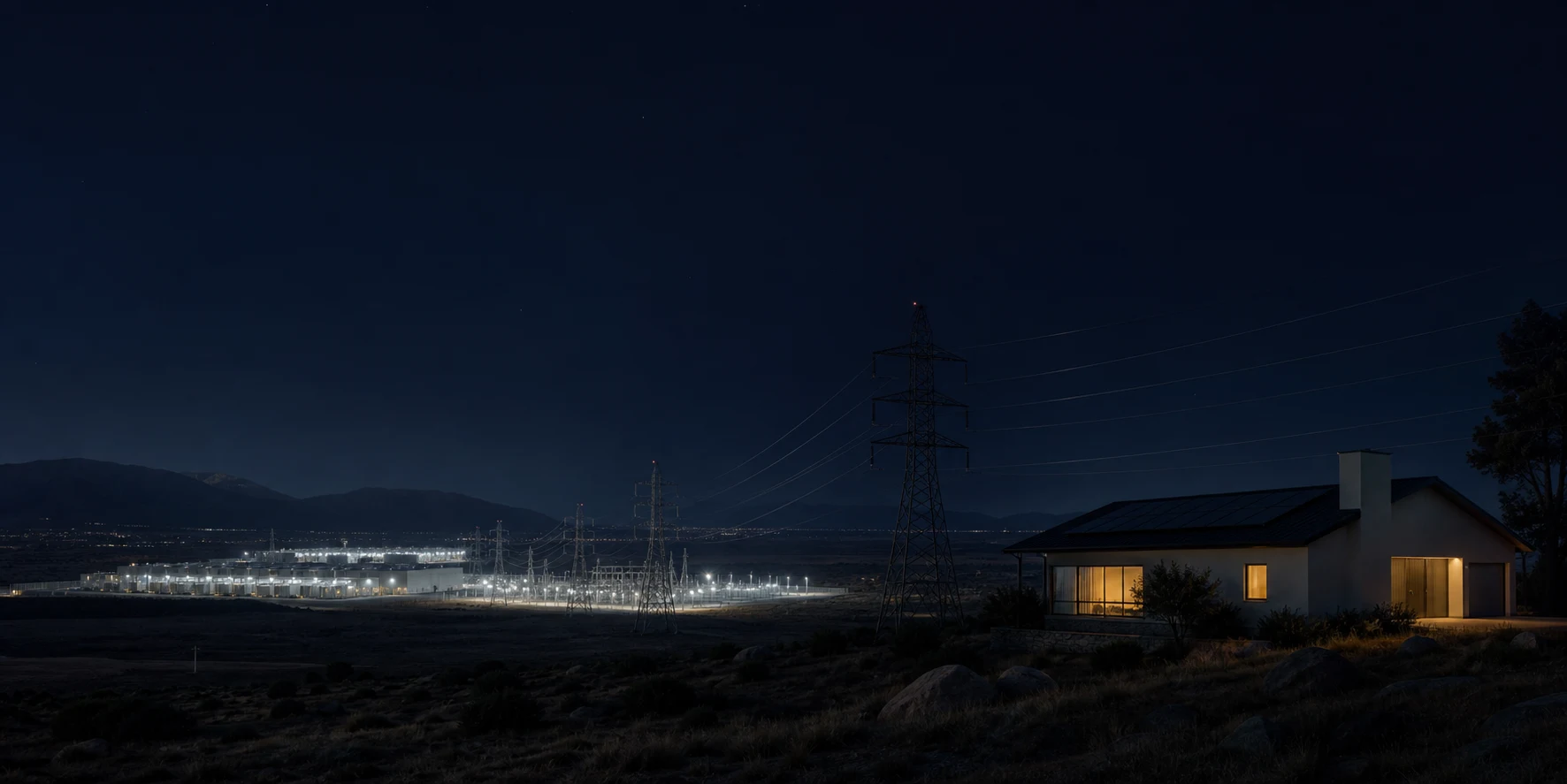
A rural home connected across the landscape to a distant data center and substation at night

California electricity costs · 02

Power is not guaranteed. The bill is.

Your consumption can fall while the shared system grows. New load. New capacity. New rate design. You do not control the inputs—but you receive the output.

California is the focus; rates, fixed charges, and rules vary by utility. Forecasts are not guaranteed outcomes, and data-center demand does not automatically set household bills.

Demand grows Costs are allocated The bill arrives

Already have solar and batteries?

Ungrid turns battery, solar, load, and weather data into alerts and daily guidance. Fully off-grid or still connected and working toward energy neutrality: put the system you own on watch.

See supported systems and monitoring

Victron VRM and EG4 Cloud monitoring · Read-only · Start free

Planning your first system?

Use these chapters to understand the tradeoffs, then bring your loads, reserve needs, and written quotes to a local installer.

Request an installer introduction

A new class of load

Your home now shares a grid with industrial-scale computing.

California’s Energy Commission estimates that data centers represented roughly 1,000 megawatts—about 2% of CAISO peak demand—in early 2026. Its planning projection reaches about 4,500 megawatts, or 9%, by 2040.

A forecast is not destiny. It is a signal that infrastructure planners and regulators are already treating data centers as material electric load.

Infrastructure is not free

New demand requires new capacity.
Who pays is a policy choice.

Large new loads can require network upgrades, generation, and backup capacity. Regulators and utilities decide how much the new customer pays directly, how much enters the broader rate base, and how risk is allocated if a project changes course.

Industrial load applies Infrastructure expands Regulator sets rules Costs reach customer classes

AI demand does not automatically raise your bill dollar-for-dollar. Rate design decides who bears the cost. That decision is exactly the exposure.

The curve keeps moving

California rate forecasts are outrunning inflation.

The CPUC’s September 2025 outlook forecast average annual residential-rate growth from 2025 through 2028 of 6% for PG&E, 7% for SCE, and 6% for SDG&E, against 2.6% inflation.

These are regulatory forecasts, not guaranteed outcomes. Inflation is not the only driver; wildfire mitigation, generation, transmission, financing, and other approved costs also matter.

PG&E
6%
SCE
7%
SDG&E
6%
Inflation
2.6%
CPUC SB 695 report ↗

Connection has a price

Your roof makes power.
They still set the terms.

You invest in solar. You reduce what you draw from the grid. But staying connected still carries a charge—even when your panels generate more electricity than your home uses.

~$24/ month

Before you buy a single kilowatt-hour.

Standard residential Base Services Charge
California investor-owned utilities

Using less won’t reduce it. Solar generation credits won’t erase it.

Approximate standard charge; actual amounts vary by billing days. This shifts some costs out of per-kWh rates.

Read the charge and solar-credit rules ↗
Your roof.
Your investment.
Their terms.

You can change how much power you need. You don’t control how the connection is priced. The CPUC sets this charge and can change its amount and structure. Investing in your own generation doesn’t give you control over those decisions.

Oversight is not omniscience

Approved does not always mean effective.

California’s State Auditor has found weaknesses in utility wildfire-mitigation oversight and questioned whether some spending was sufficiently effective or well targeted. Regulation creates accountability. It does not eliminate waste, delay, or imperfect execution.

This is not a claim that every utility dollar is wasted. It is evidence that shared-system spending can miss its objective while customers remain exposed to the cost.

The alternative is optionality

Put the decision at your house.

Independent power is not anger at the grid. It is generation, storage, reserve, and operating rules designed around your actual loads.

Make the next step specific

Get a local perspective on independent power.

Share your ZIP code and build stage. Ungrid will review your request and email you if we identify an installer serving your area.

From conviction to operation

Put independent power on watch.

Ungrid helps homes, farms, and yachts understand what their energy system is doing now—and prepare for what comes next.

One morning, one clearer decision. An illustrative Sunrise Energy Brief: overnight use leaves less reserve, clouds shorten the next solar window, and the owner moves flexible loads into the expected clearing. Ungrid provides the context; the owner decides what to run.

Show the receipts